Showing posts with label Cinema. Show all posts

Wednesday, 10 July 2013

Spotlight Review- Vicky Cristina Barcelona


As I am currently melting into my short shorts I had a sudden rush...(an epiphany perhaps?) to write a review of a gloriously summery film to get me in the mood for holiday season! Woody Allen's 2008 perky offering, set against the beautiful backdrop of Barcelona, is so wonderfully balanced and provides such easy viewing for a hot summer afternoon. Pour out the Pimms and snuggle into a comfy sofa because our director wishes to take you on a journey.

In Woody Allen's Barcelona... the people are amourous and seductive, the food, scrumptious and tempting, while the the sights are..well, beyond glorious.  He plans to entice you in... encouraging you to become enamoured by both the characters and their surroundings.

   The narrative follows two best friends, vacationing in Barcelona, eager to have a break away from their hectic city lives. Vicky (Rebecca Hall) is engaged to the reliable Doug, and is a firm realist, whose aspirations in life are down-to-earth and traditional, while Cristina (Scarlett Johansson), is far more fanatical and spontaneous, refusing to be tied down by love and commitment. *Enter* an bohemian artist Juan Antonio (Javier Bardem- YES PLEASE) who attempts to sweep both girls of their feet, by offering to accompany them to the cultural city of Oviedo, where (in his words) 'they can take photographs and make love'. Eager to explore life as a free spirit, the charismatic stranger induces stirrings of curiosity within the impressionable Cristina while Vicky, is impassive to his request, sensing his interest towards them is little more than empty lust. Nevertheless, against Vicky's better judgement, the girls do eventually follow him to Oviedo; a trip that results in both of them falling for him (its Javier. Lets be honest..who wouldn't?). 

With the two ladies smitten, it's a waiting game to see which one is destined to win the spaniard's affections; a feat further intensified by the introduction of Juan Antonio's strikingly beautiful yet damaged ex-wife Maria-Elena (Penelope Cruz), whom he still feels perpetually draw to. Cruz delivers an Oscar worthy performance as this fragile yet altogether fiery and passionate woman, driven mad by her search to find the 'missing piece' in her past relationship ('We came so close to perfection you and I' she hisses).

In short, it's a film about fidelity, love and passion all wrapped up in the gorgeous exterior of it's Spanish setting. Passionate encounters are given vibrancy by the beautiful plucking of spanish guitars and orange-filtered lighting, while dramatic showdowns are skewed by the beauty of their location into being philosophical and deep. Definitely a film to add to any summer watchlist, as it marks a sensational return to form for veteran director Woody Allen. 

Has anyone else watched it? Please comment below! :)

__________________________________________________________________
*looking at some of these stills made me tempted to add my own spin! {Just a humorous bit of mid-week fun!)


Alternative Film Quotes 

'B*tch please. Everyone knows I'm the baddest chicka in town'
'He redecorated. Oh God. The. Mess.'

'What can I say? I'm just totally fab-ulous darhhhling'

Tuesday, 4 June 2013

Spotlight Review: In Bruges


Been dying to see this! As a massive Ralph Fiennes fan, I was intrigued by the notion that the oh-so-very-prim and proper polite English gent would take the role of a foul-mouthed cockney gangster. Ralph, you 'avin a mid-life crisis, bro? 

...............................................................................................

The tagline reads 'Shoot First, Sightsee Later'. From this little nugget we should already presume that this is not a conventional gangster film. No, screenwriter Martin McDonagh is far too clever for that. Instead he has created a wonderfully tempting potion of  
cutting wit and cobbled street cat-fights (between grown men)...all paired with a cracking plot, that holds your attention firm in it's grasp.

    Defying convention, gone is the dirty city underbelly, and greasy gangster mobs...in it's place is remarkably human tale of two hitmen forced to hide out in the beautiful historic city, of Bruges [It's in Belgium...apparently], after a job goes wrong. With nothing left to do but wait, the two go to sightsee, with Ray (played by Colin Farrell) being bored out of his brains ['Bruges is a shithole'] while the older, more mature veteran hitman Ken (Brendan Gleeson) happily takes in the culture ['Bruges is NOT a shithole']. It is not until the elusive and beautiful Chloe saunters onto the scene, that Ray finally starts to embrace the city, striking up a sweet yet edgy romance. This much-needed happiness is short lived, however when news arrives that his boss, Harry (Ralph Fiennes) has come to the city to take him out, for good. 

Farrell is sheer perfection, in his best role to date, as an immature and rude young man, who at his heart is still innocent and good-natured. Throw in a midget, a belfry tower and a whole lot of f-words, here you have one of the finest modern British {independent} films ever made. It's cheeky, it's crass, it's unrestrained...but most of all it's deeply honest and touches upon the fragility of human nature.

...................................................................................................

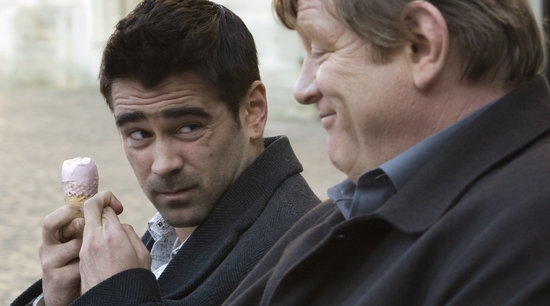
**Farrell's eyebrows do deserve a special mention seeing as throughout the film they work like little furry caterpillars up and down Colin's face, providing a range of amusing poses. LOVIN' HOW YOU WORK IT COLIN.

The Faces of Farrell {Lookbook}:


'I haven't the foggiest'
'This ice-cream tastes of sh*t, man'

'F**king Bruges'

Tuesday, 28 May 2013

Film Circle- The Fallen Treasure of Silent Cinema


   Ahhh, in our technologically advanced era where everyone is able to play around with tinted filters on Instagram, add surround sound to home movies, and be able to experience 'another dimension' of cinematic viewing (reference to the awfully dull 3D phenomenon) the roots of honest filmmaking and innovation has been lost. While many would get annoyed at the constant whirring and clicking noises that come from the old 20's and 30's silent films I'm going to step out there and say..I find it remarkably charming. The fact that there are so many little quirks littered throughout (wonky camera angles, wobbly lighting etc) makes the films seem so much more genuine and realistic; they don't have that distinctly manufactured feel of so many of our Hollywood blockbusters of today.


The intriguing element of silent cinema is that because they didn't have the luxury of sound, filmmakers tried to make up for this by creating visually impressive avant-garde settings, as backdrops to their films. Visual perfection was achieved through bold and geometrically complex shapes, to build up foreboding jagged landscapes, as well as the heavy use of shadowing, to create an unnerving eerie atmosphere (especially in their horrors). This is what we sometimes lack in modern filmmaking, as the abundance of equipment and money mean that visual effects, are reliant on advanced computer technology rather than organic human imagination. That's not to say 21st century cinema is completely blind to it's origins, in German expressionism, as Tim Burton reportedly cited late 20's silent horror as the primary influence for his 2007 musical Sweeney Todd The Demon Barber of Fleet Street. 

I appreciate that sitting and watching a film that has virtually no sound, let alone any spoken dialogue, to most people would be a living nightmare (hell, a lot of people can't even put up with subtitles) but if you can hack it then I implore you to check a few out. 
Certainly American and German expressionist silent films are now available online and even on DVD (from providers such as Lovefilm). Here are some of my picks, which I believe could turn your opinion:

1) The Cabinet of Dr Caligari (1920)

Perhaps one of the most famous and pioneering silent films of the 20's, which set a standard for expressionist horrors. Francis, a young man, recalls in his memory the horrible experience he and his fiancée Jane have been through, when they visited the charismatic Dr Caligari's exhibition. A grotesque figure Cesare (who is remarkably similar to Frankenstein's monster) is awakened by Caligari as an attraction to the show, and is kept in the cabinet. However when Cesare is let loose, and murders start occurring within the town, Francis must fight to keep his beloved Jane safe from this monstrous figure. The film used stylized sets, with abstract, jagged buildings painted on canvas backdrops and flats to build up dramatic tension and unease. This strange style is further enhanced by the the actors, who use jerky and dance like movements to create a distinctly anti-realist and unnerving atmosphere, as if projected from a nightmare.

2) Metropolis (1927)

Perhaps one of the most important films to the science fiction genre, with it's futuristic dystopian setting echoing civil unrest and the inevitable clashing of the class system in 20th century society. The film is set in a initially idealistic future, where the city of Metropolis is prosperous and its wealthy residents live a carefree life. One of those is Freder Fredersen, son of the man who founded the great city. One day, he spots a beautiful woman with a group of children, who quickly disappear. Trying to follow her, he, oblivious to such, is horrified to find an underground world of workers, apparently who run the machinery which keeps the above ground Utopian world functioning. He sets about redressing the balance but he doesn't foresee the grave consequences. Although at the time the film was far from a financial success and critically, it polarized opinion, it has however emerged as one of the most important films in cinema history.

3) The Man Who Laughs (1928)

An erratic fusion of tragic melodrama and swashbuckling adventure with the earliest threads of gloomy horror. It is based upon Victor Hugo's novel about the life of Gwynplainethe son of a disgraced aristocrat, whose face is mutilated by order of the King, so that he should always be laughing. His grotesque appearance, of a permanent grin, therefore leads to social exclusion and rejection by the shallow aristocracy of English society. He does eventually find comfort and acceptance when he meets and falls in love with a beautiful blind woman Dea, yet a devastating turn of events threatens to tear them apart. Tragic and haunting the film manages to retell this epic drama in a way that leaves a profound impression on the viewer long after the last credit has graced the screen.